Commercial spaces for rent: London and its evolving office real estate market
As we enter the first quarter of 2026, the London office market is continuing to evolve rapidly. The gap between what a modern business needs, and what the average Central London landlord offers, has widened into a chasm. For those searching for commercial spaces for rent London is a city where record-breaking rents are the entry price for sustainability, with an emerging secondary market where refurbishment projects are increasingly prevalent to meet these same environmental standards.
The State of Play: Q1 2026
The market in 2026 is characterised by a “flight to quality” that has significantly bolstered the value of best-in-class assets. In the City and West End, the demand for Grade A, ESG-compliant space remains robust, with investment volumes in the capital rising significantly year-on-year. In the City and West End, the demand for Grade A, ESG-compliant space has outstripped supply so severely that “pre-letting” is now a necessity for the survival of large firms.
Recent data highlights a stark reality. While overall vacancy across the capital hovers around 8%, this figure is deceptive. In the West End’s core, Grade A vacancy remains incredibly tight, frequently dipping below 3%. Meanwhile, secondary “Grade B” stock – that is, buildings with outdated ventilation, poor natural light, and subpar insulation – makes up more than 80% of the vacant space in the city.
The Central London Rental Reality
| Location | Prime (Grade A) Rent (Per Sq. Ft) | Grade B Rent (Per Sq. Ft) |
| Mayfair & St James’s | £130-182.50 | £85-115 |
| City | £87.50-100 | £70-80 |
| Canary Wharf | £50-60 | £35-45 |
| Chiswick/White City | £45-55 | £35-45 |
Source: here.
The ESG Countdown: A “Fix or Fail” Market
A primary driver of market activity in 2026 is the progression toward the EPC C deadline of 2027–28. Landlords are actively responding to these requirements; we are currently seeing a widespread “green-refit” wave across the city. This proactive approach is modernising the capital’s stock, though it does temporarily restrict move-in-ready supply as buildings undergo comprehensive upgrades.
For tenants, this creates a competitive landscape for high-spec, ready-to-occupy spaces. Businesses seeking an ESG-compliant headquarters are increasingly looking for assets that already meet or exceed the EPC B rating, ensuring the long-term likelihood of continuing to meet ESG requirements. Increasing prices for Grade A office spaces in central London have led many SMEs to look for office space elsewhere in the city.
Three Currents Defining the 2026 Market
Beyond sustainability, for those searching for commercial spaces for rent London is being reshaped by three specific structural shifts that are changing how businesses occupy space.
- The Rise of “Managed” Offices
The market is moving away from the traditional binary choice of a long-term lease or a coworking desk. There has been a significant surge in “Managed Office” supply. These are typically self-contained suites that are fully fitted and managed by a third party but branded as the tenant’s own.
This “third way” has become the primary choice for mid-sized firms. In early 2026, managed space has been increasing in excess of 100% year on year in London takeup. It allows companies to protect their cash flow by avoiding massive upfront fit-out costs while maintaining a private, branded environment.
- The “Flight to Character” vs. Glass Towers
While Grade A glass skyscrapers in the City still command high rents, a parallel “flight to character” has emerged. Occupiers are increasingly bypassing traditional glass boxes in favour of refurbished Victorian warehouses or industrial heritage sites retrofitted with modern tech.
- The “Hospitality-Infused” Workplace
The line between a hotel and an office has blurred. It is no longer enough to offer a desk; the office must now actively compete with the comfort of home to drive attendance.
- The Insight: Buildings with high “amenity scores”, offering concierge services, luxury “End of Trip” facilities (showers and bike hubs), and rooftop terraces, see better attendance rates and acceptance of hybrid working than those without. This aligns with work-life balance now being a bigger deciding factor than salary when working for an employer.
The Connectivity Factor
The Elizabeth Line continues to redefine London’s geography. Prime transit-linked locations are commanding significant premiums; for instance, areas like Farringdon have seen nominal rent growth of over 45% since the line’s inception. This level of accessibility has effectively decentralised the “must-have” business map, allowing firms to prioritise building quality and amenities over a traditional WC1 or EC2 postcode.
Venture X West London: Coworking without Compromise
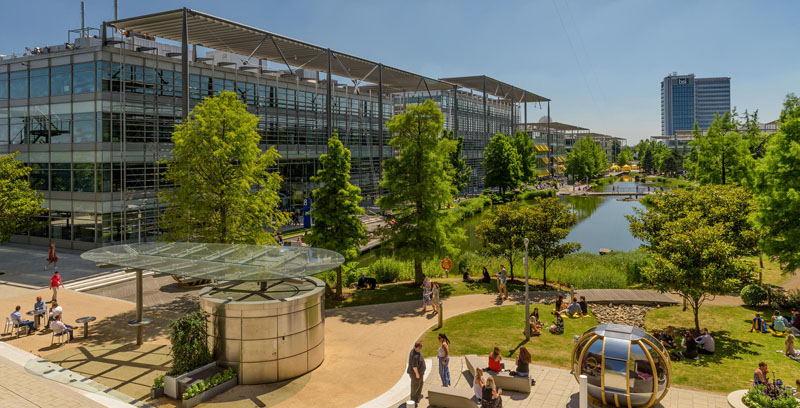
At Venture X, we’ve watched these market shifts closely. We recognised that the 2026 occupier doesn’t want to choose between a “budget” office and a “bank-breaking” lease. Our locations in Chiswick Park and White City provide the premium, Grade A experience that Central London demands, but with the agility of a coworking model.
What makes Venture X the smarter move?
- High-Spec Design: Ergonomic furniture and sit-stand desks are standard, not an “upgrade.”
- True Scalability: Move from a 2-person office to a 20-person suite in the same building as you grow. No 5-year lease commitments required.
- The Community Effect: With like-minded professionals all around during the day, networking has never been less forced.
- Zero Hidden Costs: In a market where service charges and business rates are skyrocketing, our flat-fee membership covers everything from ultra-fast WiFi to the coffee in the kitchen.
For those searching for commercial spaces for rent London continues to get more competitive, the smart money is moving West. Whether you need a hot desk for a day or a private office for a year, Venture X provides the “best-in-class” environment that 2026 demands, at a price point that makes sense for your bottom line. Get in touch if you’d like to transform the way you work.